


Every spring of my teenage years, I was measured and fit for new football equipment. They measured my height, my weight, the width of my shoulders, and even the circumference of my head.
“Hmm…” said the czar of pads and helmets as he measured my skull. “You’re a ‘tweener.”
This was the ruling every year. We were never quite sure whether I belonged in a medium or a large helmet—I was stuck in between. If we chose medium, I would deal with headaches from the pressure. If we moved up to large, it was a little too loose, which looked funny (a terrible way to look in high school), and lost some of its protective benefits.
I remember this seemingly innocuous comment, decades later, because it has described so much of my life.
***
My best friend growing up had a brother a year older than we were. For a few years, I found myself hanging out with his brother and his friends more than kids my age—we just seemed to understand each other better. I’m hesitant to call it maturity (we certainly weren’t very mature), but hanging out with the older kids just felt more comfortable. Maybe it was growing up with two older sisters (one four years older, another eight), but I never quite felt like I fit in with my classmates. The close friends I did make were ‘tweeners of their own right, spending time in just about every social circle but really only belonging in our own.
This followed me to college, where I quickly discovered an undergraduate student club focused on entrepreneurship. I was a freshman, and the club was full of juniors and seniors who were all-in on tech (this was the period of Facebook, Uber, Airbnb, etc.) It was so cool just to be around them. They had big business ideas, and they were DOING them—in college!
Shortly after graduation, several of them moved to the West Coast (San Francisco and Seattle) to immerse themselves in startups. Many of them are now post-economic (i.e., they made enough to retire). I stayed involved in the club as I got older and they had graduated (I eventually led it as president), but I couldn’t recreate that magic. What’s more, I never quite felt like I was on their level to begin with.
In every season of my life, I’ve always been an inbetweener. I was virtually always the youngest person in the room, which came with equal parts exhilaration and isolation. I felt like I had somehow snuck into a space I didn’t belong in. I was always excited, but also a bit terrified that someone would ask, “How old are you?” When I’d answer, they’d always make the same face—a look that was equal parts shame and disbelief. Disbelief because I present as older, and shame because they believed it. I’ve maintained a beard since my early 20s in hopes to stave off the question entirely.
I’ve never outgrown this. Even today, I identify with the perspective of parents and people 5-10 years older than me. The audience analytics across all my content channels show my audience is typically 5-15 years older than me. My wife and I moved into a new neighborhood, and we seem to be the youngest couple.
I started my content business in 2017, which was both years ahead of most creators today but years behind the class of bloggers like Pat Flynn, Mark Manson, Tim Urban, or Maria Popova. Somehow, I was both late to blogging and podcasting, and too slow to take social media more seriously.
One constant throughout all this time has been my ability to build community. Whether it was leading clubs, organizing in-person events like Startup Weekend, or online communities like SPI Pro and The Lab, I’ve always had a knack for creating space for people.
Maybe it’s because I’ve spent so much time feeling out of place that I really want to create a space where I feel at home.
My friend David Spinks shared this post, which I felt a little too personally:
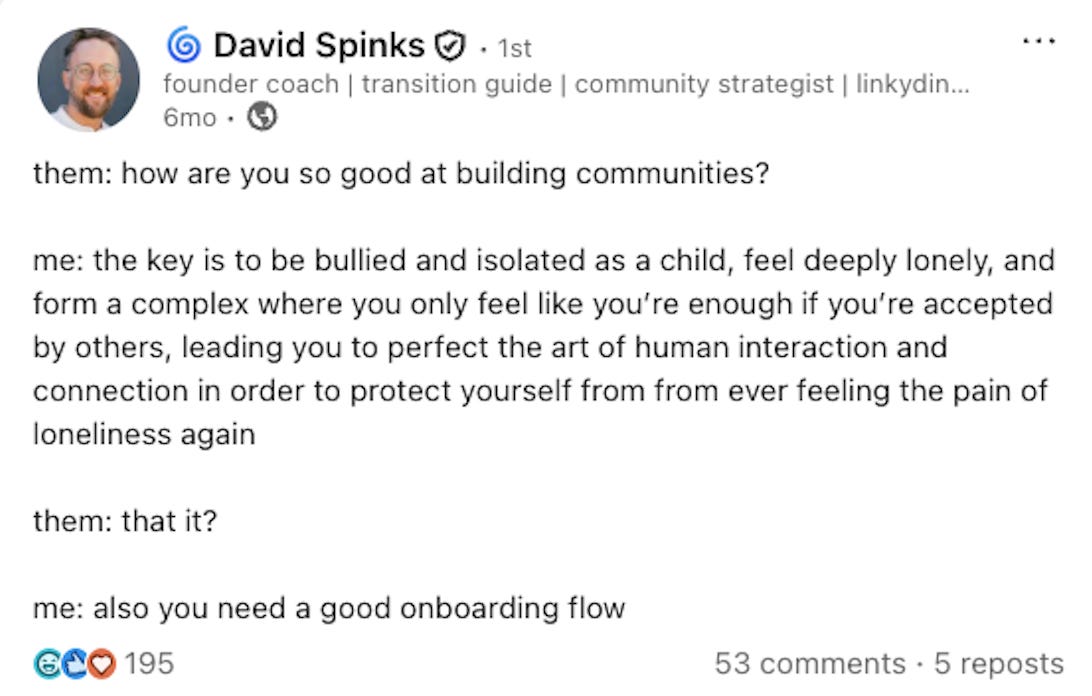
The painful irony for community builders, though, is that when you play such a crucial role in the formation and moderation of a space, the community itself treats you a little differently. Not badly, but actually with a certain amount of respect and esteem reserved only for the leader(s) of that space. It’s kind, it’s flattering, but ultimately it actually creates distance between you and the rest of the community, which feeds into the same pattern of loneliness and isolation as before. So, by creating a space where you feel you belong, you actually create conditions in which just fitting in is more difficult.
I share all this because I’ve been thinking about friendship a lot lately.
When my wife and I were planning our wedding, one of the first decisions was how many guests to invite. Once family is accounted for, the question comes down to friends—and that forces some uncomfortable clarity.
What is a friend? Depending on how you define it, I may have two thousand friends—or maybe I just have two. As I’ve gotten older, I’ve realized that while my outer ring of friends has expanded, my inner circle seems to have gotten much smaller.
Now that we have a daughter and are growing our family, I’m noticing that my “village” is actually pretty small. Our neighbors are friendly, but none of them are friends. Their kids are several years older than ours, or they’re empty nesters.
By spending a decade striving, I deprioritized many friendships. Of course, I’m friendly with many of the people I’ve met over the years, but I haven’t made many new lifelong friends. Worse, I lost touch with some of my oldest friends—and you can’t make new, old friends.
So after a decade of helping people become better creators, I find myself as a creator pulled to explore how to become a better person. Instead of connecting with an audience, I want to better connect with myself and the people around me. Maybe this identity of being an “inbetweener” isn’t something I need to hold onto. Maybe through different actions and priorities, I can actually feel comfortable belonging.
That’s what I’ll be exploring here on this Substack. If you’re interested in joining me on that journey, I’d enjoy your company.
my brother...
as i was reading the first few paragraphs i felt like i could have written the same thing. always hung out with older groups. always felt more connected to adults than kids my age. so much resonance.
so as i'm reading and nodding along, it was a delightful little surprise to see you quote my post.
and just yesterday in therapy and today with ai, i've been doing some deep processing of complex childhood trauma around loneliness and lack of safety, and how it led me to pursue the work and career i've pursued. so all of this lands.
i know the transition you're navigating well. really fucking excited for you. and if you want to talk through anything, know that i'm in your corner always.
love you.
Love this reflection Jay. I've been a fan of your work for years. It inspired me in no small way to do what I'm doing now, which is helping people with exactly this challenge. It's usually people in corporate. High performing achievers who optimized for success, striving and doing but maybe skipped the BEing part. It's a beautiful path your on and you're asking the right questions. I look forward to following your journey, and if I can ever be of assistance I'd be happy to compare notes.
Be Rebellious!